
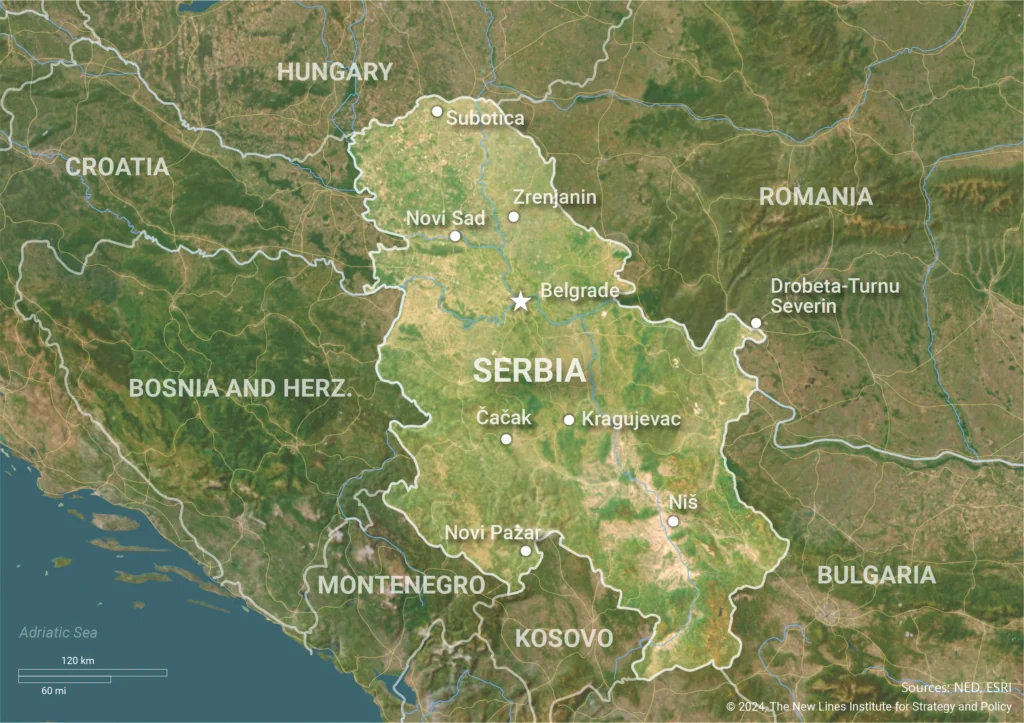
In the complex theater of international relations, few countries occupy a position as precarious and fascinating as Serbia. Often described as “a house built in the middle of the road,” Serbia sits at the crossroads of the East and the West. To navigate the competing interests of global superpowers, Belgrade has adopted a sophisticated strategy characterized by strategic hedging and rhetorical spinning.
This posture is not merely a product of indecision; it is a calculated survival mechanism. By balancing its aspirations for European Union membership with deep-rooted ties to Russia and a growing partnership with China, Serbia seeks to maximize its security and economic autonomy.
The Doctrine of Military Neutrality
The cornerstone of Serbia’s national security is the principle of military neutrality, formally declared by the National Assembly in 2007. Unlike many of its neighbors in the Balkans who rushed to join NATO, Serbia has remained outside the alliance. This decision is deeply influenced by the collective memory of the 1999 NATO bombing, which remains a sensitive pillar of Serbian public opinion.
However, neutrality does not mean isolation. Serbia’s hedging strategy involves a high degree of cooperation with NATO through the Partnership for Peace program and the Individual Partnership Action Plan (IPAP). Simultaneously, Belgrade maintains a “special relationship” with the Russian-led Collective Security Treaty Organization (CSTO). By engaging with both sides, Serbia ensures that it is never fully dependent on a single security guarantor.
The Russian Connection: Energy and Diplomacy
For decades, Russia has been viewed as Serbia’s traditional protector, primarily due to shared Slavic and Orthodox heritage. In modern terms, this relationship is sustained by two critical factors: energy and the Kosovo issue.
- Energy Dependence: Serbia relies heavily on Russian natural gas. The acquisition of Serbia’s oil industry (NIS) by Gazprom Neft solidified this bond, making energy security a key component of national security.
- Diplomatic Support: As a permanent member of the UN Security Council, Russia provides Serbia with a crucial veto regarding the recognition of Kosovo’s independence.
Belgrade “spins” this relationship to its domestic audience as an unbreakable brotherhood, while internationally, it presents it as a pragmatic necessity for territorial integrity.
The Rise of the “Steel Friendship” with China
In the last decade, a new player has entered Serbia’s hedging equation: China. Belgrade has become a central hub for China’s Belt and Road Initiative (BRI) in Europe. This partnership, often labeled a “steel friendship” by officials, provides Serbia with billions in infrastructure loans and investments without the stringent political conditions often imposed by Western institutions.
From a security perspective, the China-Serbia link has evolved from economics to defense. Serbia was the first European country to deploy Chinese-made FK-3 surface-to-air missiles and CH-92A combat drones. By diversifying its military hardware, Serbia reduces its reliance on any one power, ensuring that its defense capabilities remain functional even if one geopolitical channel is closed.
The European Union: The Elusive Goal
While hedging toward the East, Serbia’s official strategic goal remains membership in the European Union. The EU is by far Serbia’s largest trading partner and provider of financial assistance. However, the path to accession is fraught with “security” requirements, most notably the normalization of relations with Pristina and alignment with EU foreign policy—including sanctions against Russia.
This is where the “spinning” becomes most evident. To the EU, Belgrade emphasizes its commitment to European values and regional stability. To its voters, the government portrays the EU as an economic tool that should not dictate the nation’s traditional friendships or its stance on Kosovo.
The Risks and Rewards of Strategic Hedging
The primary reward of this posture is strategic flexibility. By not being fully integrated into any single bloc, Serbia can play different powers against each other to extract the best possible deals in trade, infrastructure, and defense.
However, the risks are mounting, especially in the wake of the conflict in Ukraine. The “hedging space” is shrinking as the West demands clear alignment.
| Geopolitical Partner | Primary Benefit to Serbia | Primary Security Risk |
| European Union | Economic growth and institutional reform. | Loss of sovereignty and pressure over Kosovo. |
| Russia | UN Security Council support and energy. | Secondary sanctions and isolation from the West. |
| China | Massive infrastructure and high-tech defense. | Long-term debt and “debt-trap” diplomacy. |
| USA / NATO | Regional stability and military standards. | Domestic backlash due to 1999 history. |
Spinning for a Domestic Audience
A crucial element of Serbia’s security posture is how it is communicated at home. The government utilizes a sophisticated media apparatus to “spin” these complex maneuvers. When the President meets with Western leaders, the narrative focuses on “Serbia as a respected European partner.” When he meets with Vladimir Putin or Xi Jinping, the narrative shifts to “Serbia as a sovereign nation that bows to no one.”
This dual narrative ensures that the government maintains a broad base of support, satisfying both the pro-European urban population and the more traditional, pro-Eastern rural demographic.
Conclusion: The Future of the Balancing Act
Serbia’s national security posture is a high-wire act. Hedging has allowed the country to modernize its military with diverse technology and attract global investment while maintaining its stance on territorial issues. However, as the world moves toward a more bipolar or fragmented order, the cost of “sitting on two chairs” is rising.
Belgrade’s ability to continue this strategy will depend on its skill in refining the “spin”—convincing the West that it is a necessary partner for Balkan stability, while convincing the East that it remains a loyal, non-aligned friend. In the world of realpolitik, Serbia remains one of the most interesting case studies of how a small state manages the giants.
